VU DMSTI doktorantūrų kryptys
Pavadinimas, tikslas, objektas, iki šimto žodžių
Žodžių (ir frazių ?) sentimentinio panašumo nustatymas.
Pirmas būdas – naudojant kažką pabašaus į ” embedded wordvecs”, pvz Sense Sentimental Similarity 2012. Reikia didelių language corpuses ir supratimo, „how to embed the supervising knowledge”
Antras – through enriching wordnet with other thesauri and word-emotion annotations and clustering algorithm,
Currently semantic algorithms are not good enough (as they often consider antonyms to be more similar than synonyms, see appendix below).
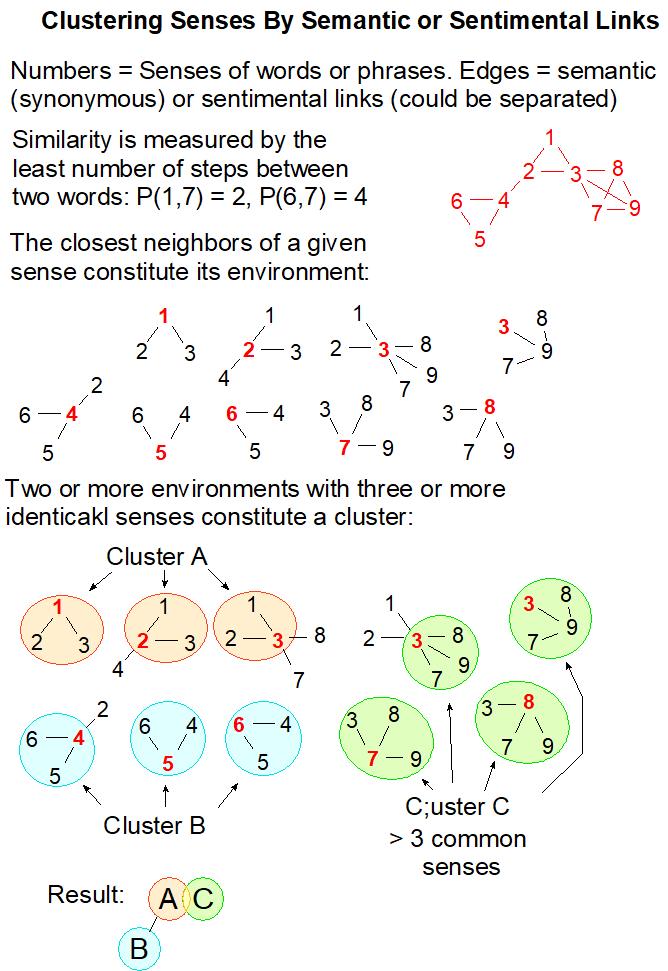 Our clustering algorithm showed that wordnet can be clustered into one major graph (~ 30,000 senses) and several dozen smaller graphs that need further interlinking (within each cluster and among all). Thus wordnet has to be enriched by synonyms, near synonyms, antonyms, and near antonyms from other thesauri (like Merriam Webster and Word Hippo). Adding the available word-emotion associations could also help. Further improvement can be achieved by assigning each synset (extended to common phrases) with „sentimental descriptors“ from categorical emotion annotations and our own crowdsourcing. Two examples of what’s available:
Valence, Arousal, and Dominance for 20,000 English Words
100,000 commonsense concepts (in 40 languages, indexed by 8 continuous sentiment scales)
See also Dimensional emotion detection from categorical emotion annotations. Ideally sentimental similarity should be defined by N-D coordinates of any given word or phrase in a space defined by N+1 reference words or phrases. Alan Cowen’s Emotion Maps represent an example of 2-D case of this.
These algorithms will help to map internet contents according to our inner feelings, identify the most direct (yet smooth enough) psychological transformations, get „healing“ material when we are in trouble (e.g. deep depression, heartache, etc), and generally find information in a messy environment (typical to most websites of large organizations) through automated conversion of their data into „sentimental graphs“ – like Visual Thesaurus, but extending far beyond
Lietuviško Wordneto sudarymas ir integravimas su kitų kalbų Wordnetais. The wordnet includes ~ 100,000 common synsets (documented senses after excluding all single-standing technical terms) many of which are available in all major languages (see Open Multilingual Wordnet and UWN with each word in up to 200 languages)
Daugiasluoksniai Panašumo Grafai – Multilevel Similarity Graphs, maybe similar to Semantic Web and Common Sense Knowledge Graphs. Each object can be characterized by multilevel hierarchy of sentimental words. E.g., Forrest Gump can be linked to a combination of the strongest „first-impression-words“, like „Handicapped + Boy + Modesty + Perseverance + Success“ (primary traits), as well as „Endurance + Obedience + Nobility + …“ (secondary traits) , and „Politics + Vietnam + Running + Shrimps + Watergate + …“ (tertiary, factual, keywords; a more detailed description is given here). For this we will need „sentimental similarity“ algorithms
The Universal Concept Graph. The starting set of our keywords will come from the wordnet. Semantic Similarity Algorithm started as synset clustering algorithm that identifies the shortest path between any two wordnet’s synsets. Further development requires enriching wordnet with other thesauri (Merriam Webster and Word Hippo) as outlined above, and possibly adding word-emotion associations. Then expand with datasets of tweets along with annotations to emotions (see also Seemo: a computational approach to see emotions)
Semantinių ir Setimentinių sąryšių vizualizavimas. See Visual Thesaurus, Word Vis, Via Lab, Github Wordnet Atlas, also Google wordnet visualization and Wordnet alternatives
(i) „Subtlety / marginality“ indices measuring the distance of a given sense to the „moral center“ of entire concept graph. Currently in the Atlas of Feelings it is represented by letters a-j. This will orient us (and AI algorithms) in the space of moral values. Often we get disoriented due to dismissing broader possibilities. The entire concept graph will show us all such possibilities along with final moral outcomes
(ii) „Under- and over-developed“ states, that will enable automated determination of how different senses or concepts interact with each other: strengthen, oppose, create new meanings, remain neutral, or influence interactions of other pairs of senses. For example, under-developed Courage is Cowardice, whereas over-developed Courage is Foolhardiness. Under-developed Creativity is Conformity, whereas over-developed Creativity is Eccentricity. Since both senses (Courage and Creativity) have synonymous under- and over-developed forms, they enhance each other. But if their respective forms were antonymous, they would diminish each other (like Courage and Prudence). A set of senses with mixed interactions may constitute „self-organizing homeostasis“ leading to new existential dimensions. E.g., Courage + Creativity + Prudence + Responsibility may lead to Firmness, Brilliance, Foresight, and Resoluteness, whereas Fright + Submission + Safety may lead to maladaptive schemas.
This type of analysis enables the „rule-driven Artificial Wisdom“ (AW), that can supervise the conventional AI, making it „more Human“, respecting our feelings and Moral Values, and enhancing our wisdom
Eventually we will get a graph of concepts that will generate new dialectical „situation maps“ (or Custom Atlases) „on the fly“, based on peculiarities of any given context of recordings. E.g., there are works that identify our emotions from what we say or write – our system will tell how these emotions can be balanced or transformed into something wiser and more useful
The Global Wisdom Network will emerge as a result of crowdsourced concept graph with ever-improving sentimental similarity algorithms and hierarchical linking of all types of internet contents. A three-step procedure will lead the user to the practical results:
(1) identify problem(s) using the Boost Me Up app,
(2) see what these problems are related to, and how others dealt with them, using the Fee-Links service,
(3) get practical suggestions using the AW algorithms and on-fly „situation maps“
Identify. Observe. Solve.
Prepare the crowdsourcing platform using the Heraclitus 24 system that relates our Atlas of Feelings to several thousand of affect-related synsets from wordnet (for access contact alanas196560@gmail.com).
It is now designed for simultaneous use by only few users. For crowdsourcing purposes it must become like wikipedia.
Instead of using only few thousand wordnet synsets, it must use all available synsets
It is now in English only – other languages must be added too (we have Russian and Lithuanian wordnets, but see Open Multilingual Wordnet and UWN)
We must add more synonyms, near synonyms , antonyms and near antonyms from Merriam Webster and Word Hippo and Thesaurus Plus and Thesaurus.com
Visualizing wordnet has not started. See Visual Thesaurus, Word Vis, Via Lab, Github Wordnet Atlas, also Google wordnet visualization and Wordnet alternatives
A hierarchical system for mapping internet could be similar to a goodreads tag system empowered by something like hierarchical tags, extended using Common Sense Knowledge Graphs
Semantic Similarity Algorithm started as synset clustering algorithm that identifies the shortest path between any two wordnet’s synsets. Further development requires enriching wordnet with other thesauri (Merriam Webster and Word Hippo) as outlined above, and possibly adding word-emotion associations
Then expand with datasets of tweets along with annotations to emotions
What else is available on the internet:
Tools for semantic analysis up to 2017 – from 135 p.
Sentiment Analysis Tools Overview, Part 1. Positive and Negative Words Databases
SocialSent: Domain-Specific Sentiment Lexicons for Computational Social Science
Free software to measure semantic similarity, but the results are disappointing, e.g. prudent + thoughtful (synonyms!) = 0.193, but prudent + careless (antonyms!) = 0.43; eccentric + odd (synonyms!) = 0.35, but eccentric + normal (antonyms!) = 0.275
Figuring the semantic similarity of words
How to measure semantic similarity of words?
SenseClusters -a package of (mostly) Perl programs that allows a user to cluster similar contexts together recommended by wordnet, another link is here
Google:
affective computing
common sense knowledge graphs
semantic technology
semantic web
Psichologija ir Marketingas
Jausmų Atlaso integravimas su įvairiais psichologiniais modeliais (žr. Maturity Profiles, ir Atlas vs Big Five)
Vartotojų nuotaikų ir charakterio ypatumų kaupimas ir tyrimas; Interfeiso optimizavimas remiantis fokuso grupių tyrimais (possible interfaces). The „Boost Me Up“ App for emotional entertainment and identification of our daily moods, character traits and dilemmas.
Psuchologinių rizikos grupių profilaktinis gydymas sentimentinio appso pagalba
Unmasking of self-delusions by a cascade of dialectical checkups. For example, how to know whether something is an „objective reality“(cell 13-c) or just a „subjective conviction“ (13-e)? Checking your feelings in all segments rotated by every 90 degrees will provide an initial estimate: if you are not sure about your Security (1-c), Perseverance (7-c), or Attention (19-c), then you may be in trouble. The reliability of diagnostics is increased by checking all adjacent segments and „non-systemic“ relations („related to“, „confused with“, „incompatible with“ relations). The quickest checkup may only take a minute, but the meticulous checkup may require substantial time to go through many iterations
 The Neuro-Infotainment impact on patient’s moods and character traits. Transforming the mood using the neuro-info-tainment app (The Fee-Links service). For each problem it will offer selected daily quotes, stories, videoclips, practical advices), helping to overcome maladaptive schemas, laziness, harmful habits, stress, loneliness, suicidal thoughts, fear, and so on. Basically it’s NLP, Wellbeing, Mental Health business.
Creating a „global psychological map of humanity“, using the crowdsourcing platform for rating links between different psysets („related to“, „confused with“, „incompatible with“), and assigning them with various sentimental indices and dialectical attributes. that will make psychology a more fundamental science
Psychlogical disorder treatment by matching people with complimentary moods, characters, values, skills. (Roughly, if you have any gray / red cells, you need a person with white / yellow cells from 90 and / or 180 angled segments.)
Finalize app’s possible interfaces, generalize maturity profiles, develop app’s 1st version and try on focus groups
Add Jeffrey Young schemas, optionally Dungeons and Dragons characters, 12 archetype characters, greatest movie characters, archetypes and stock characters for screenwriters, …
Integrate emotion Gifs, optionally Alan Cowen’s emotions’ vocalizations, music, videoclips, cultural flavors, (mapping emotions), Ryerson facial expressions (RML), Ryerson Emotional Speech and Song (RAVDESS), Toronto emotional speech (TESS), Improv spontaneous improvisations (MSP and here)
Useful guidance books: Virginia Satir Iceberg Model in Coaching and Psychological Disorders: DSM-5