Our goal is to create the universal problem solving system through converting Common-Sense Knowledge Graphs (CSKGs) into the „time-vortex” maps (a.k.a. multidimensional dialectical atlases or the „4th Law of Thermodynamics”)
For this we need to develop a new type of concept-mapping software capable of visualizing the existing
 Humanity spends uncountable resources for „battling global problems“ while ignoring the very source of all such problems: our scalar / commutative thinking.
We propose a system that will identify various „conflicting concepts“ on local and global scales and suggest the ways for their resolution. The Online Atlas of Feelings is an example of such a system for our feelings and character traits (see draft article submitted to the Journal of Philosophy of Emotion). It can also be used for converting all existing knowledge into a „self-sustainable problem solving mechanism“, based on „algebraic dialectic“.
Our idea is two-fold. First, prepare a crowdsourcing / hypothesis generating framework based on the „universal concept graph” with vast visualization and manipulation capabilities: merge wordnet with various thesauri, conceptnet, develop semantic / sentimental similarity algorithms, visualize not just semantic trees, but also linguistic/root, within one language or among many, psychological/sentimental chains, cause-effect chains, undeveloped-overdeveloped chains, and whatever else would prove useful
Second, invite people to crowdsource through various „teaser applications”, like language learning / mood boosting / decision-making apps
The first part is like a „concept mining / hypothesis generating platform”, the second – the actual data.
We need a competent „direction kick” for selecting the right tools for the first part (concept visualization / manipulation and crowdsourcing). I have asked our programmer-guy to look for graph-visualizing / concept mapping / decision making tools that could help converting the existing concept graphs to above-mentioned monster
можно создать систему, которая позволяла бы превращать existing common sense knowledge graphs (that already include millions of concepts) into directed dialectical maps (like my wheels in Figures 3,5, but multidimensional). Then we will focus on converting all knowledge into such dialectical graphs. Knoweldge can be increased through game0driven crowdsourcing
это будет напоминать систему ТРИЗ на уровне психологии, философии а потом и всех остальных
напр цикл Креббса – это тоже диалектический граф
у меня уже есть алгоритм для превращения всех слов и концептов в такие графы
The general concept graph. We could start with simply visualizing Word-net and Concept-net, using free graph-visualization and mind-mapping tools
Graphs can be: similarity (e.g., synonymous relations), relational (hyponyms – hypernyms, or set-subset-subsubset), time flow (cause-effect-cause-effect, functional relations), dialectical (chains of oppositions with smoothly increasing subtleness, like multidimensional Atlas of Feelings)
Our software should allow adding new concept nodes, annotating every node or edge with numeric, text or graphic info
Numeric / textual annotations can be converted to coordinates (e.g., through semantic / sentimental similarity) for plotting all concepts in a „hypothesis-generating” spaces
Scalable for large amounts of data (billions of concepts) and large numbers of users (like wikipedia)
connect our feelings, moods and character traits to various practical situations and global internet contents, and transform it to a „problem solving mechanism“
The „Boost Me Up“ App. The Atlas of Feelings can be converted to an app (see possible interfaces) for emotional entertainment and identification of our daily moods, character traits and dilemmas. The identified results can be presented in a variety of forms based on „Maturity Profiles“ (that will be further systemized and expanded as outlined in the Appendix below)
This app will identify our psychological shortcomings („internal bottlenecks“), based on localization of red and grey cells, using several self-evaluation scenarios (quick, medium, meticulous). Many our self-delusions can be unmasked by a cascade of dialectical checkups. For example, how to know whether something is an „objective reality“(cell 13-c) or just a „subjective conviction“ (13-e)? Checking your feelings in all segments rotated by every 90 degrees will provide an initial estimate: if you are not sure about your Security (1-c), Perseverance (7-c), or Attention (19-c), then you may be in trouble. The reliability of diagnostics is increased by checking all adjacent segments and „non-systemic“ relations („related to“, „confused with“, „incompatible with“ relations). The quickest checkup may only take a minute, but the meticulous checkup may require substantial time to go through many iterations
The „Fee-Links“ Service.  For each problem it will offer daily „neuro-infotainment“ – email messages with „Healing Links“ that are currently displayed on the right side of the screen (selected quotes, stories, videoclips, practical advices). Some of these links will be offered for free („Free-Links“), others will require paid subscription („Fee-Links“). Eventually these links will be empowered by ever-increasing „global concept map“ with „sentimental similarity“ and „Artificial Wisdom“ algorithms (see below)
The Crowdsourcing („Soul-pedia“) Platform. All such „Healing Links“ will be crowdsourced by our app’s users (using the „sharing wisdom“ option). Each link will be provided with the history of placement and quality ratings from other users. User will be able to rate these links (based on which their authors will be rewarded), share his own links and wisdom pertaining to various cells and situations (psysets), and get rewarded for the accurate placements. Some links may be gathered automatically, using various „concept maps“ (like Unionpedia or Babelnet or Conceptnet) or searching internet with specific queries (e.g. „Art of <sense>“ – Art of Bravery, or dilemmic TEDx on Brave or Stupid). In future we may also use „deep“ language models (such as BERT, GPT-3, T5, etc) that will be trained by our own (crowdsourced) material
„Healing Links“ will help to „overcome yourself“, e.g., get rid of harmful habits, stress, loneliness, fear, and so on. Basically it’s NLP, Wellbeing, Mental Health businesses.
The crowdsourcing platform can also be used for rating links between different psysets („related to“, „confused with“, „incompatible with“), and assigning them with various sentimental indices and dialectical attributes. Both of these will provide a basis for the „global psychological map of humanity“ that will make psychology a more fundamental science
Matching People. A user will be able to chat and meet with other people with complimentary mood, character, values, skills. Roughly, if you have any gray / red cells, you need a person with white / yellow cells from 90 and / or 180 angled segments. People with orthogonally oriented pairs of „struggling oppositions“ can lift each other to „higher consciousness“, if their white cells are also orthogonally oriented.
Our advantages will come from better knowledge of each person based on hierarchical classification of his values, moods and traits, that will come not only from the diagnostic tests, but also from the wisdom he shared and ratings he provided for various „Healing Links“. As will be described below, each link can point to various coordinates on the global concept graph (with subtlety indices), thus providing more information about a person’s inner state.
Hierarchical indexing. The collected material will be linked with „secondary“ and „tertiary“ keywords via a hierarchical system. For example, Forrest Gump can be linked to a combination of the strongest „first-impression-words“, like „Handicapped + Boy + Modesty + Perseverance + Success“ (primary traits), as well as „Endurance + Obedience + Nobility + …“ (secondary traits) , and „Politics + Vietnam + Running + Shrimps + Watergate + …“ (tertiary, factual, keywords; a more detailed description is given here). For this we will need „sentimental similarity“ algorithms that are outlined below.
The Universal Concept Graph. The starting set of our keywords comes from the wordnet that includes ~ 100,000 common synsets (documented senses after excluding all single-standing technical terms) many of which are available in all major languages (see Open Multilingual Wordnet and UWN with each word in up to 200 languages)
This graph will be visualized like in Visual Thesaurus or Word Vis (more ideas in the appendix below)
It has to be united with the Conceptnet.io and Babelnet.org– multilingual knowledge bases, representing words and phrases that people use and the common-sense relationships between them
It should be enriched by additional links and sentimental descriptors (from thesauri and emotion annotations) to produce „sentimental similarity“ algorithms that convert any messy information into „semantic / sentimental graphs“.
Semantic / Sentimental Similarity. Currently such algorithms are not good enough (as they often consider antonyms to be more similar than synonyms, see appendix below).
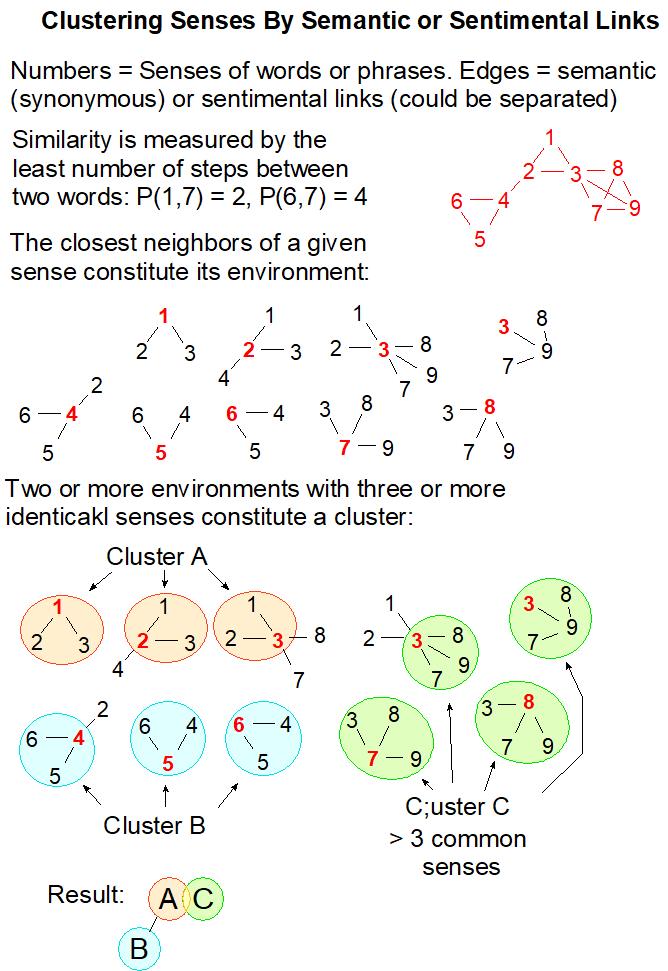 Our clustering algorithm showed that wordnet can be clustered into one major graph (~ 30,000 senses) and several dozen smaller graphs that need further interlinking (within each cluster and among all). Thus wordnet has to be enriched by synonyms, near synonyms, antonyms, and near antonyms from other thesauri (like Merriam Webster and Word Hippo and Power Thesaurus). Adding the available word-emotion associations could also help
Conceptnet.io – a multilingual knowledge base, representing words and phrases that people use and the common-sense relationships between them
Further improvement can be achieved by assigning each synset (extended to common phrases) with „sentimental descriptors“ from categorical emotion annotations and our own crowdsourcing. Few examples of what’s available:
Valence, Arousal, and Dominance for 20,000 English Words
100,000 commonsense concepts (in 40 languages, indexed by 8 continuous sentiment scales)
Concept Net – semantic network of words’ meanings
Ideally sentimental similarity should be defined by N-D coordinates of any given word or phrase in a space defined by N+1 reference words or phrases. Alan Cowen’s Emotion Maps represent an example of 2-D case of this.
As outlined above, these algorithms will help to map internet contents according to our inner feelings, identify the most direct (yet smooth enough) psychological transformations, get „healing“ material when we are in trouble (e.g. deep depression, heartache, etc), and generally find information in a messy environment (typical to most websites of large organizations) through automated conversion of their data into „sentimental graphs“ – like Visual Thesaurus, but extending far beyond
The Artificial Wisdom. All synsets and psysets should also be provided with two types of „dialectic attributes“ to enable „Artificial Wisdom“ (AW, as opposed to AI):
(i) „Subtlety / marginality“ indices measuring the distance of a given sense to the „moral center“ of entire concept graph. Currently in the Atlas of Feelings it is represented by letters a-j. This will orient us (and AI algorithms) in the space of moral values. Often we get disoriented due to dismissing broader possibilities. The entire concept graph will show us all such possibilities along with final moral outcomes
(ii) „Under- and over-developed“ states, that will enable automated determination of how different senses or concepts interact with each other: strengthen, oppose, create new meanings, remain neutral, or influence interactions of other pairs of senses. For example, under-developed Courage is Cowardice, whereas over-developed Courage is Foolhardiness. Under-developed Creativity is Conformity, whereas over-developed Creativity is Eccentricity. Since both senses (Courage and Creativity) have synonymous under- and over-developed forms, they enhance each other. But if their respective forms were antonymous, they would diminish each other (like Courage and Prudence). A set of senses with mixed interactions may constitute „self-organizing homeostasis“ leading to new existential dimensions. E.g., Courage + Creativity + Prudence + Responsibility may lead to Firmness, Brilliance, Foresight, and Resoluteness, whereas Fright + Submission + Safety may lead to maladaptive schemas.
This type of analysis enables the „rule-driven Artificial Wisdom“ (AW), that can supervise the conventional AI, making it „more Human“, respecting our feelings and Moral Values, and enhancing our wisdom
Eventually we will get a graph of concepts that will generate new dialectical „situation maps“ (or Custom Atlases) „on the fly“, based on peculiarities of any given context of recordings. E.g., there are works that identify our emotions from what we say or write – our system will tell how these emotions can be balanced or transformed into something wiser and more useful
The Global Wisdom Network will emerge as a result of crowdsourced concept graph with ever-improving sentimental similarity algorithms and hierarchical linking of all types of internet contents. A three-step procedure will lead the user to the practical results:
(1) identify problem(s) using the Boost Me Up app,
(2) see what these problems are related to, and how others dealt with them, using the Fee-Links service,
(3) get practical suggestions using the AW algorithms and on-fly „situation maps“
Identify. Observe. Solve.
Appendix: Useful Resources & Problems to Be Solved
Finalize app’s possible interfaces, generalize maturity profiles, develop app’s 1st version and try on focus groups
Add Jeffrey Young schemas, optionally Dungeons and Dragons characters, 12 archetype characters, greatest movie characters, archetypes and stock characters for screenwriters, …
Integrate emotion Gifs, optionally Alan Cowen’s emotions’ vocalizations, music, videoclips, cultural flavors, (mapping emotions), Ryerson facial expressions (RML), Ryerson Emotional Speech and Song (RAVDESS), Toronto emotional speech (TESS), Improv spontaneous improvisations (MSP and here)
Potentially, convert moods’ spectra into unique melodies (using SuperCollider or Max/Msp)
Useful guidance books: Virginia Satir Iceberg Model in Coaching and Psychological Disorders: DSM-5
Prepare the crowdsourcing platform using the Heraclitus 24 system that relates our Atlas of Feelings to several thousand of affect-related synsets from wordnet (for access contact alanas196560@gmail.com).
It is now designed for simultaneous use by only few users. For crowdsourcing purposes it must become like wikipedia.
Instead of using only few thousand wordnet synsets, it must use all available synsets
It is now in English only – other languages must be added too (we have Russian and Lithuanian wordnets, but see Open Multilingual Wordnet and UWN)
We must integrate with Conceptnet.io and/or Babelnet.org
We must add more synonyms, near synonyms , antonyms and near antonyms from Merriam Webster and Word Hippo and Thesaurus Plus and Thesaurus.com
Visualizing wordnet has not started. See Visual Thesaurus, Word Vis, Via Lab, Github Wordnet Atlas, also Google wordnet visualization and Wordnet alternatives
A hierarchical system for mapping internet could be similar to a goodreads tag system empowered by something like hierarchical tags, extended using Common Sense Knowledge Graphs
Semantic Similarity Algorithm started as synset clustering algorithm that identifies the shortest path between any two wordnet’s synsets. Further development requires enriching wordnet with other thesauri (Merriam Webster and Word Hippo) as outlined above, and possibly adding word-emotion associations
Then expand with datasets of tweets along with annotations to emotions (see also Seemo: a computational approach to see emotions)
What else is available on the internet:
Tools for semantic analysis up to 2017 – from 135 p.
Sentiment Analysis Tools Overview, Part 1. Positive and Negative Words Databases
SocialSent: Domain-Specific Sentiment Lexicons for Computational Social Science
Free software to measure semantic similarity, but the results are disappointing, e.g. prudent + thoughtful (synonyms!) = 0.193, but prudent + careless (antonyms!) = 0.43; eccentric + odd (synonyms!) = 0.35, but eccentric + normal (antonyms!) = 0.275
Figuring the semantic similarity of words
How to measure semantic similarity of words?
SenseClusters -a package of (mostly) Perl programs that allows a user to cluster similar contexts together recommended by wordnet, another link is here
Google:
affective computing
common sense knowledge graphs
semantic technology
semantic web